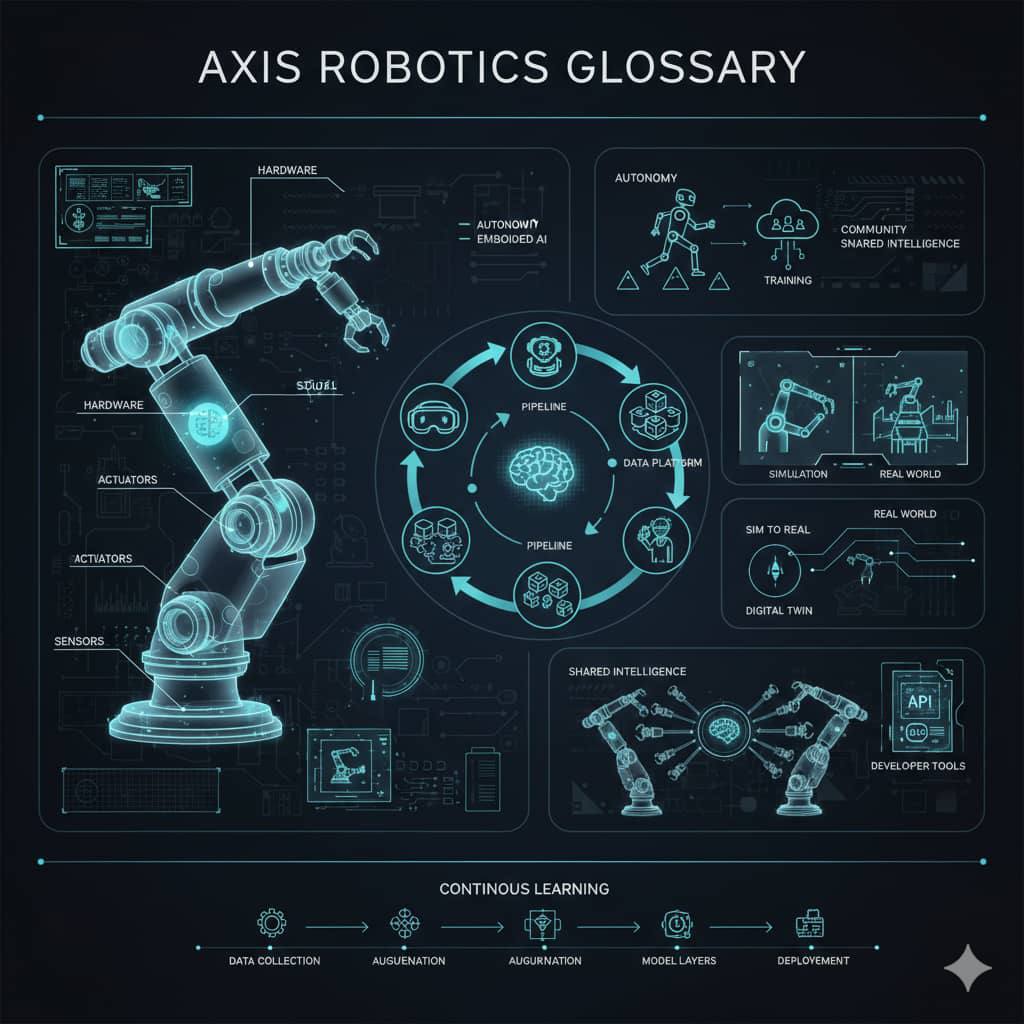
Glossary
Short explanations of key terminology used throughout the handbook.
AxisRobotics Glossary
Simple definitions of key terms.
Platform & Intelligence
- AxisRobotics — A platform that helps robots learn skills from humans using data, simulation, and real world practice.
- Robotic Intelligence — The ability of a robot to understand tasks, make decisions, and act correctly in the real world.
- Embodied AI — AI that learns through physical interaction with the real world, not just text or images.
- Autonomy — A robot’s ability to perform tasks on its own without constant human control.
- Robot Platform — The complete physical robot system, including hardware and control software.
- Shared Intelligence — Knowledge learned by one robot that can benefit many robots.
- Collaborative Learning — Learning that improves through contributions from many humans working together.
- Learning Ecosystem — The combination of humans, robots, data, and tools that work together to improve robotic intelligence.
- Scalability — The ability for a system to grow and support many robots, tasks, and users without breaking.
- Automation — Using robots and AI to perform tasks automatically with little or no human involvement.
Simulation & Deployment
- Simulation — A virtual world where robots practice safely before working in real life.
- Digital Twin — A virtual copy of a real robot used for testing, training, and experimentation in simulation.
- Sim to Real — The process of transferring skills learned in simulation to real robots.
- Real World Execution — When a trained model controls a physical robot in the real world.
- Deployment — Placing a trained model onto a real robot to perform tasks.
- Safety Layer — Controls that prevent robots from acting in harmful or dangerous ways.
- Execution Framework — The system that connects AI models to robots and controls how actions are performed.
- Pipeline — A step-by-step flow from data collection → training → testing → real-world use.
- Feedback Loop — A cycle where robots act, mistakes are found, and learning improves over time.
- Continuous Learning — The process where robots keep learning and improving over time.
Models, Training & Data
- Model — The “brain” of the robot software that decides how the robot should move and act.
- Training — Teaching the AI model by showing it many examples until it learns patterns.
- Training Data — Information collected from robot actions, including movements, successes, and failures.
- Data — Recorded information such as robot movements, actions, sensor readings, and results.
- Data Platform — A system that stores, organizes, and manages all robot learning data.
- Data Contribution — When humans provide useful robot data through demonstrations, testing, or corrections.
- Data Augmentation — Creating new training examples by modifying existing data to improve learning.
- Human in the Loop — A learning process where humans guide, correct, or improve robot behavior.
- Teleoperation — When a human remotely controls a robot to teach it how to perform tasks.
- Community Contribution — When many people help improve robot intelligence by sharing data, skills, or feedback.
Hardware Terms
- Hardware — The physical parts of a robot, such as arms, motors, sensors, and controllers.
- Sensors — Robot components that collect information about the environment (vision, force, position).
- Actuators — Parts that make the robot move, like motors and joints.
Developer Terms
- SDK (Software Development Kit) — A set of tools, libraries, and examples that help developers build with AxisRobotics.
- API (Application Programming Interface) — A structured way for software systems to communicate with AxisRobotics services.
- Library — Reusable code that helps developers perform common robot tasks faster.